
DEVELOPMENT STRATEGY
Pipeline of IVPE Cost Reduction Strategies
Each program targets high-cost therapies and validates more efficient alternatives — turning clinical insight into real, measurable savings for health plans.
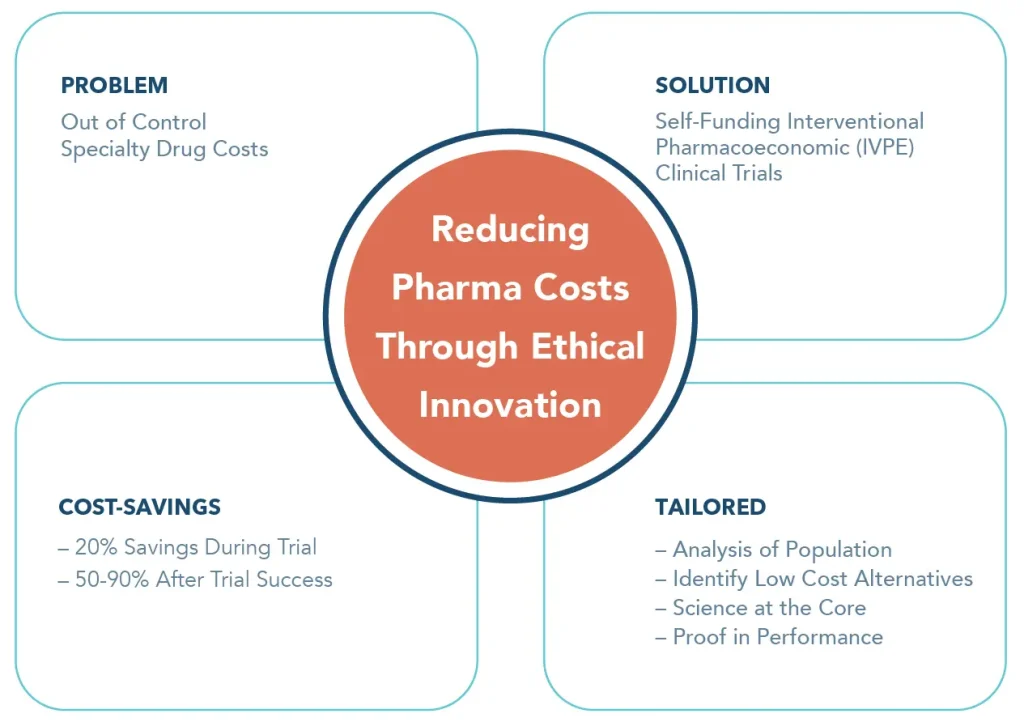
At Public Good Pharma, we are advancing cost-effective healthcare through a series of Interventional Pharmacoeconomic (IVPE) clinical trials.
These trials aim to validate lower-cost therapies as alternatives to expensive specialty drugs. Below are our six primary IVPE use cases, with supporting links to relevant studies.
Our pipeline reflects a commitment to improving healthcare affordability while maintaining the highest standards of patient outcomes. Explore these and other studies to understand how we are driving innovation in cost-containment strategies.
IMPORTANT INFORMATION: The proposed IVPE clinical programs below are presented for information purposes only and not medical advice, and would be conducted under FDA and ethics committee oversight. The therapies, dosing regimens, and uses discussed have not been reviewed, approved, or endorsed by the U.S. FDA for the purposes described.

GLP-1 Dose Optimization
- Study: Comparison of GLP-1 treatments ($12-14k+ annually) to gradual tapering to a behavioral and dietary intervention ($2k annually) for sustainable weight loss.
- Outcome: Supporting affordable behavioral interventions for long-term obesity management with cost savings + identifying biomarkers for tapering with better outcomes.
Less frequent dosing of GLP-1 receptor agonists as a viable weight maintenance strategy

Oncology Dose Optimization
- Study: Dose de-escalation of Pembrolizumab ($120k+ annually) and Nivolumab ($150k+ annually), where payers are currently charged over $30b annually.
- Outcome: Helping validate lower dosing regimens to save over 50% annually per member and reduce side-effects + identifying biomarkers and adjunct therapies for better outcomes.

Affordable Cell & Gene Therapies
- Study: Comparison of commercial CAR-T (Kymriah, ~$450k per treatment) vs. in-house CAR-T (~$35k per treatment) for leukemia and lymphoma.
- Outcome: Immediate savings of ~$90k per patient during the trial and ~90% savings versus commercial CAR-T, subject to FDA approval, and extending to other in-house gene therapies.

Orphan Drug Development
- Study: Comparison of Ravicti ($800k annually) vs. ATX-018 ($80k annually) for Urea Cycle Disorder.
- Outcome: Expected 20% cost savings of ~$160k annually per member enrolled during the trial and 90% cost-savings compared to current price of Ravicti, subject to FDA approval.

Biosimilar Repurposing
- Study: Comparison of Ocrelizumab ($80k annually) vs. Rituximab biosimilar ($8k annually) for Multiple Sclerosis.
- Outcome: Immediate savings of ~$16k annually per member during the trial and ~90% savings compared to current price of Ocrelizumab, subject to FDA approval.

Generic Drug Repurposing
- Study: Comparison of Esketamine ($25k annually) vs. IV/IM Ketamine (<$1k annually) for Treatment-Resistant Depression.
- Outcome: Racemic IV/IM ketamine is 100% bioavailable and likely non-inferior or superior to esketamine at less than 1/400th of the cost, offering immediate and long-term cost reductions, subject to FDA approval.
Partner with Public Good Pharma
Our IVPE programs offer self-insured employers a compliant and forward-thinking solution to specialty drug cost management, legal risk mitigation, and better healthcare outcomes. Contact Us Today to learn how we can support your compliance and cost-saving goals.